
Broward County Criminal Court Cases
The Seventeenth Judicial Circuit is Broward County's trial-court system. Its Circuit Court hears felonies. Broward County Court hears misdemeanors and local criminal traffic matters. The Clerk of Courts creates and maintains the docket once the State Attorney files an information, a grand jury returns an indictment, or another authorized charging paper begins the case. That court file is distinct from the arresting agency's report and BSO's booking entry.
Most central criminal work is tied to the Broward County Judicial Complex at 201 SE 6th Street in Fort Lauderdale. Regional courthouses also operate in Deerfield Beach, Plantation, and Hollywood. A file's location code matters: 10 is Central, 20 is North, 30 is West, and 40 is South. A transfer between locations does not create a new case. Use the local or Uniform Case Number to keep track of the same Broward County criminal case.
Broward Criminal Case Numbers
A Broward criminal case number is more than a serial label. The Clerk's local number uses thirteen characters: a four-digit filing year, a six-digit sequence, and a two-letter division code, with a final character when the system assigns one. Uniform Case Numbers add the circuit and county identifiers. Copy the whole value when possible because it is more precise than a name search.
- CF
- Circuit felony case.
- MM
- County misdemeanor case.
- TC
- Criminal traffic case.
- MO
- Municipal ordinance matter routed to the court.
These codes identify a docket type, not guilt. They also help explain why two results for one name may represent different legal events. Check the filing year, location, and party details before opening documents.
Searching Broward County Case Records
The free Broward Clerk Case Search is the main public route for filed state-court cases. It supports case-number and party searches, and its criminal category can be narrowed by filing dates and division. The portal may cap a result set at the first 200 matches. A common name therefore needs a tighter date range, full middle name, or known case number.
- Choose the criminal case category in Clerk Case Search.
- Enter the complete case number, or search the party's legal name.
- Narrow a broad name result by filing range, division, or case type.
- Open the matching docket and compare party, charge, location, and status fields.
- Ask the Clerk for an electronic, paper, or certified copy when the docket image is absent or official proof is needed.
| Search field | Use | Practical note |
|---|---|---|
| Case Number | Exact file lookup | Accepts local or Uniform Case Number formats. |
| Party Last Name | Name lookup | Required for a party search. |
| Party First Name | Name narrowing | Optional but useful for common surnames. |
| Middle Name | Identity narrowing | Optional; use the recorded spelling. |
| Party Type | Role filter | Optional selector. |
| Filing Date From/To | Date filter | Limits large result sets. |
| Case Category | Docket family | Select Criminal for these files. |
Broward Court Images and Copies
The public search is an index and viewing tool, but it is not itself the official record. Some entries offer document images. Others show only a docket line because the image is confidential, sealed, redacted, too old, or unavailable online. Do not treat a missing image as a missing filing. Contact the Clerk with the case number and document title.
The Felony Clerk counter is in Room 1882 of the Central Courthouse North Building and generally serves the public Monday through Friday from 8 a.m. to 3:30 p.m. The Clerk's published schedule lists $1 per page for court-record copies and $2 to certify a document, plus applicable payment or service charges. Confirm current costs before ordering. The Felony Division also explains local seal and expunge filing services.
The Broward Clerk Case Search supplied the image shown below. It illustrates why the case number and category should be ready before a broad party search.
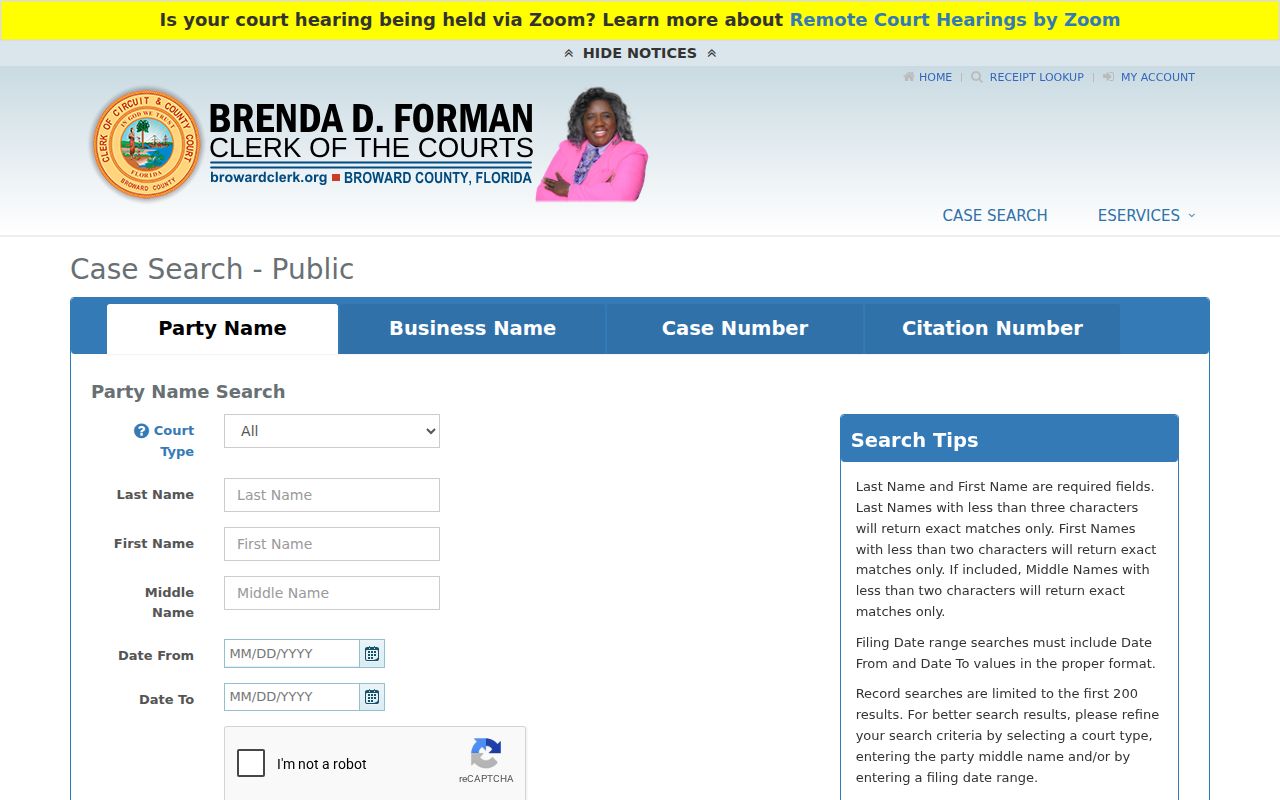
The interface is the starting point for docket research, while the Clerk remains the source for certified and non-displayed material.
Inside a Broward Criminal Case File
A Broward County court file follows the charge after filing. It can identify the court and division, show the prosecutor's charging instrument, list motions and hearing events, and record how each count ended. Read count-level outcomes. One count may be dismissed while another ends in a plea or judgment.
| Case Number and Court | Local and Uniform Case Numbers, division code, location, judge, and case status. |
|---|---|
| Charging Document | The information, indictment, complaint, or amended filing that states the prosecuted counts. |
| Docket Entries | A dated sequence of filings, notices, orders, motions, and court events. |
| Hearing Dates | Arraignment, pretrial, plea, trial, sentencing, and later review settings when public. |
| Disposition and Judgment | Count-level results such as conviction, dismissal, acquittal, or nolle prosequi. |
| Sentence and Conditions | Custody, probation, fines, credit, and other court-ordered terms shown in public documents. |
An arrest charge can differ from the filed information. It can change again through amendment or plea. For that reason, a booking allegation should not substitute for the Broward court disposition.
Reading Broward Case Outcomes
Florida docket terms can look alike while carrying different meanings. Nolle prosequi means the prosecutor formally stopped a filed charge. A dismissal also ends a charge without a trial conviction, but the docket should show who acted and when. Acquittal is a not-guilty result after adjudication by judge or jury.
Adjudication withheld means the court did not formally adjudicate guilt after a plea or finding, subject to Florida law and the stated conditions. It is not the same as dismissal. Nolo contendere means no contest. The defendant does not contest the charge, but the docket still must be read for judgment and sentence. When a shorthand entry is unclear, request the signed order rather than guessing from one line.
How a Broward Criminal Case Moves
The State Attorney decides whether the arrest allegation should become a filed charge. Once a filing reaches the Clerk, arraignment records a plea or waiver. Pretrial entries can include discovery, motions, continuances, diversion, and plea talks. A case then reaches a plea, trial, dismissal, or other disposition. Sentencing follows a conviction or adjudication when required.
Case flow: Charges Filed › Arraignment › Pretrial › Plea or Trial › Disposition › Sentencing
Broward also operates Drug Court, Mental Health Court, Veterans Court, and other problem-solving routes. These are court programs, not separate public record systems. Their permissible filings remain tied to the Clerk's case number, while treatment or confidential material may be restricted.
Broward Criminal File Custodians
The Broward State Attorney files an information or other prosecuting document, but the Clerk accepts that filing, assigns it to the docket, and preserves the court record. This split determines where a request should go. Filed charges, judicial orders, hearing entries, and the final result belong with the Clerk's case file. A separate prosecutorial public record belongs with the State Attorney's records custodian.
The Public Defender and private defense counsel may retain client or work-product material. They are not custodians of the complete public docket. Start with the official case number and ask the Clerk about any missing image. If access is restricted, the Clerk can identify the governing status without disclosing confidential content or giving legal advice.
Broward Felony Archives Before 2014
Older Broward County criminal court cases need a different path. The Clerk directs pre-2014 felony files to Archives, and research material identifies felony coverage back to 1915. The Archives counter is in Room 03305 of the East Building at the Judicial Complex. Call the Clerk at (954) 831-6565, option 3, before traveling and provide the case number, party name, approximate year, and document needed.
Archives access solves two common problems. First, an old case may be indexed but lack viewable images. Second, a portal name search may fail because an older spelling or conversion differs. A narrow request gives staff a sound place to start. It also avoids confusing a missing online result with proof that no record exists.
Case Record Access and Restrictions
Florida judicial records are generally open under Rule 2.420 and the state's public-access framework, but access has firm limits. Sealed and expunged files do not appear like ordinary public cases. Juvenile matters are restricted. Victim information, medical data, Social Security numbers, active investigative material, and other protected fields may be withheld or redacted under Florida law.
A blank image or absent name can therefore have several causes. Ask the Clerk whether the file is archived, available only at a terminal or counter, confidential by law, or subject to a court order. The custodian may explain access status but cannot give legal advice. The Seventeenth Judicial Circuit homepage pictured below helps readers confirm current division and courthouse information before contacting the proper office.
See the official circuit court source for Broward court administration and current notices.
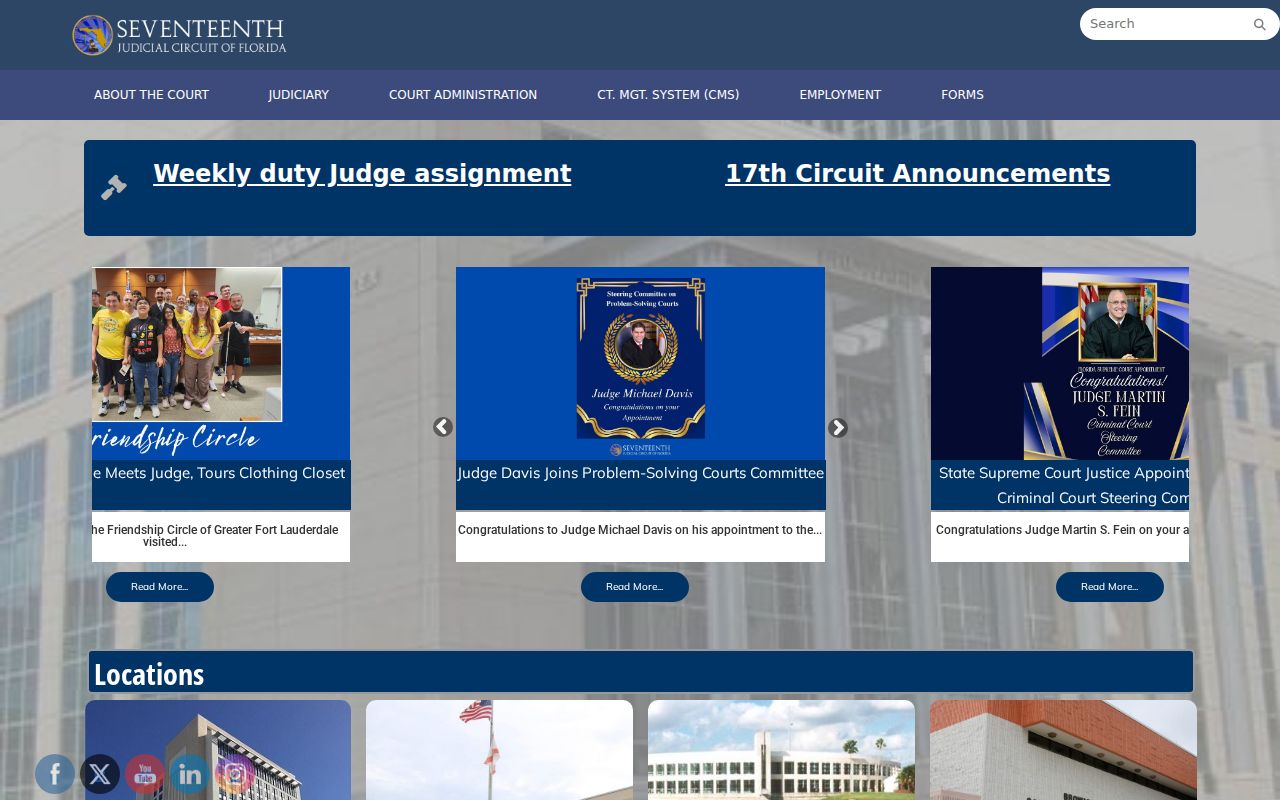
The circuit identifies the courts and divisions, while the Clerk remains custodian of the searchable case file.
The Clerk's felony page also documents local copy and record-clearing procedures. The source image below shows the official division channel.
Open the Broward Clerk Felony Division source before requesting a certified criminal file or local expunction packet.
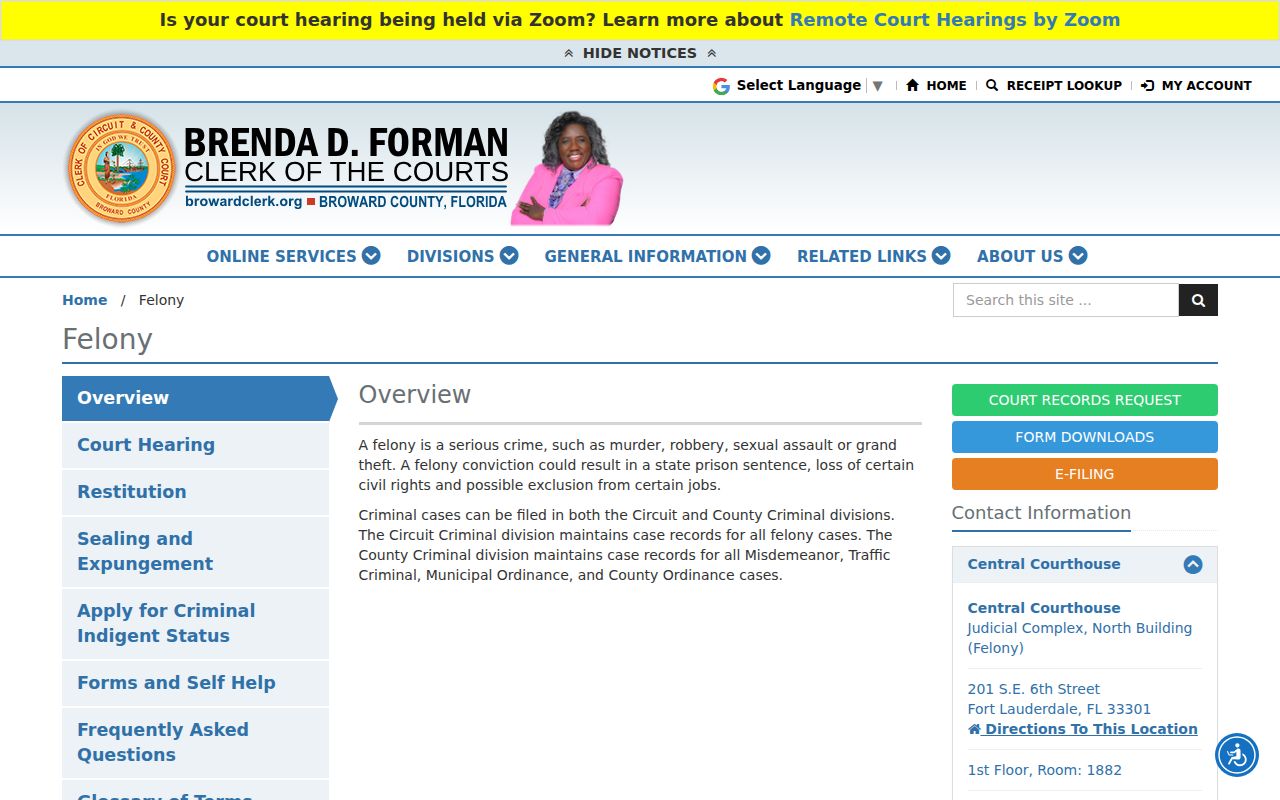
This division connects the public docket with the counter services needed when online access is not enough.